Table of contents
From cocaine routes pivoting through European ports to romance-scam rings that launder profits in minutes, transnational crime is growing faster than the borders meant to contain it, and Europe’s police cooperation model is being stress-tested in real time. Europol’s joint operations have become a central instrument, not a silver bullet but a force multiplier that can fuse intelligence, money-trail analysis, and coordinated arrests. The question is no longer whether cross-border policing matters, but how these operations actually work, what they have achieved, and where the limits remain.
When Europol joins the raid, the scale changes
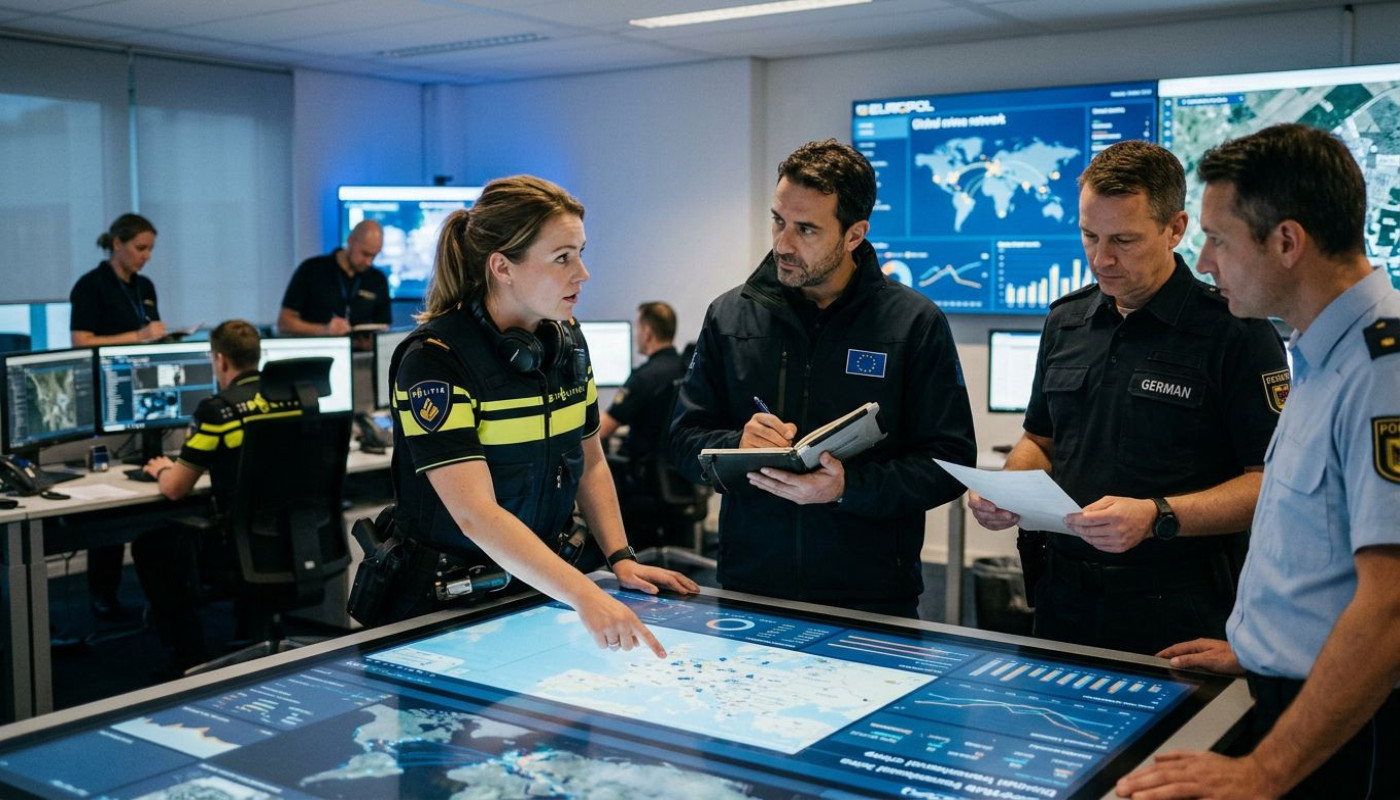
Picture the difference between a local investigation and a coordinated European operation: the first is often constrained by jurisdiction, language, and fragmented data, while the second can turn scattered clues into a single operational map. Europol is not a European “FBI” with its own power to arrest, but it is increasingly the place where national police forces meet to pool intelligence, deconflict parallel cases, and build joint action plans, and that practical role is why its joint operations have become so visible in the past decade.
In 2023, Europol supported thousands of international investigations, and it hosted more than 1,000 operational meetings to connect investigators across borders, according to its annual reporting. Its core added value is often technical and analytic rather than spectacular: cross-checking phone dumps at scale, linking aliases across databases, building social network analysis on suspects, and tracing financial flows that hop between jurisdictions. The agency’s European Serious and Organised Crime Threat Assessment (SOCTA) repeatedly highlights the same reality: organised crime in Europe is increasingly networked, digitally enabled, and financially sophisticated, with criminal groups exploiting legal business structures and logistics chains that span multiple countries.
Joint operations typically begin with a problem that no single country can “own” alone. A trafficking network may recruit in one state, transport through another, warehouse in a third, and cash out through shell companies elsewhere. In that setting, speed and synchronisation matter: simultaneous searches can prevent suspects from warning each other, and shared intelligence can stop investigators from chasing the wrong branch of a network. Europol’s coordination role is often paired with operational support on the ground, including mobile offices, specialist analysts, and real-time data checks, which can turn a national raid into a multinational strike with a single timetable.
Yet the scale shift is not only about manpower, it is about information architecture. Europol has been investing heavily in its analytical capability and data processing, and the EU has expanded the agency’s mandate in recent years, notably with the 2022 Europol Regulation update that strengthened its ability to support member states on large datasets and to cooperate with private parties under strict conditions. In practice, that means joint operations now lean more on digital evidence, platform data, and financial intelligence, and less on the slow exchange of paper-based requests that once dominated cross-border policing.
Big numbers, real hits, and what they mean
Results are often announced as arrest counts and seizures, but the more telling measure is disruption: did an operation break the logistics, the finances, and the communications that allow a network to regenerate? Europol-backed actions in recent years show that joint operations can strike multiple layers at once, from street-level facilitators to infrastructure providers and money managers, and that layered approach is what makes the headlines translate into longer-term impact.
Take the law-enforcement campaign against encrypted criminal communications. In 2020, the EncroChat takedown reverberated across Europe, generating evidence that fed into a wave of investigations and arrests, and Europol played a central coordination and analytical role alongside national authorities. The following year, the operation targeting Sky ECC produced another major shock, with thousands of suspects identified and a cascade of follow-on cases. These were not “one-off” busts; they were intelligence breakthroughs that opened historical message archives, allowing investigators to map networks, attribute roles, and connect crimes across borders.
Then there is the financial side. Europol has increasingly emphasised asset recovery and the targeting of illicit profits, because seizures of product alone rarely dismantle a network’s capacity. Its European Financial and Economic Crime Centre (EFECC) supports cases involving money laundering and high-value assets, and joint operations now frequently include financial investigators, customs, and tax authorities. The logic is straightforward: if profits keep flowing, recruitment continues, corruption risks increase, and the market quickly re-stabilises after arrests.
On cybercrime, the agency’s European Cybercrime Centre (EC3) coordinates with member states and international partners, and it has backed operations against ransomware groups and illicit online marketplaces. Here the “joint” dimension is not just geographic; it is also sectoral, because cyber investigations often require cooperation with hosting providers, domain registries, and financial intermediaries. Europol’s own public communications have repeatedly underlined the role of coordinated infrastructure takedowns, including the seizure of servers and the disruption of botnets, to reduce immediate harm and deny criminals their tools.
Still, the headlines can obscure a hard truth: disruption is rarely permanent. Criminal groups adapt quickly, shifting to new encrypted services, new payment rails, and new jurisdictions. Joint operations are therefore best understood as part of a cycle, where intelligence gains, arrests, and asset freezes buy time, reduce harm, and raise costs for offenders, even if they do not “solve” the underlying market forces that sustain trafficking, fraud, and exploitation.
Europe’s police puzzle: Europol, Interpol, and the gaps
Who does what, and why does it matter? In the public imagination, Europol and Interpol are often blended into a single idea of “international police,” but their roles are structurally different, and that difference shapes how joint operations are designed, which legal tools are available, and what outcomes can realistically be expected.
Europol is an EU agency focused on supporting law enforcement cooperation among EU member states, and its operational role is built around intelligence sharing, analysis, and coordination. Interpol, by contrast, is a global organisation with 195 member countries, best known for its notice system, including Red Notices, and for facilitating police cooperation worldwide. Europol’s added value tends to be depth within Europe, with specialised centres and integrated workflows; Interpol’s strength is breadth across continents, especially when a case extends beyond the EU’s immediate reach.
That distinction becomes concrete when investigations touch extradition, arrest warrants, and international requests. Within the EU, instruments like the European Arrest Warrant have streamlined surrender procedures compared with traditional extradition processes, and Europol can support the intelligence and coordination around those cases. Outside the EU, however, the legal and diplomatic pathways are different, and Interpol channels often become more central. For readers trying to understand this landscape, including how “Europol-style” cooperation differs from global mechanisms, resources that lay out the comparison in plain terms can help, such as Extradice Advokáti, which explains key differences in mandates and how they translate into practice.
There are also gaps that neither organisation can fully close. Europol cannot compel national authorities to act, and it cannot replace the judicial cooperation that must underpin cross-border evidence gathering. Interpol does not operate as a supranational police force either, and its notices are not arrest warrants in themselves, because national law determines what action follows. Joint operations therefore succeed when they are welded to prosecutorial strategy, court-admissible evidence pathways, and clear command structures across participating countries, and they falter when those elements are missing or politically constrained.
A further complication is trust and data governance. Sharing intelligence across borders raises concerns about source protection, ongoing investigations, and sensitive personal data. The EU has strict data protection rules, and Europol operates under a specific legal framework and oversight mechanisms, but joint operations can still be slowed by differing national thresholds for data sharing, or by legal limits on what can be transferred and how it may be used in court. In other words, the “puzzle” is not just institutional; it is legal, cultural, and operational at the same time.
What works next: speed, money trails, and public trust
The future of joint operations may hinge less on flashy raids and more on quiet upgrades: faster cross-border data access, better financial intelligence, and stronger legitimacy in the eyes of the public. Why? Because transnational crime is increasingly powered by digital platforms, professional money laundering services, and logistics that look like normal commerce, and policing strategies must evolve accordingly.
First, speed. Criminal networks exploit latency: the time it takes to translate a request, obtain authorisation, and receive data can be the margin that allows a suspect to disappear, funds to move, or evidence to be destroyed. Europol’s operational coordination helps compress timelines, but the broader system still depends on national procedures and court approvals. The EU’s ongoing debates about lawful access to data, digital evidence, and platform cooperation will shape what joint operations can do in practice, especially in cyber-enabled crime where evidence may be stored in multiple jurisdictions and moved quickly.
Second, money trails. Europol and member states increasingly treat financial investigations as central rather than auxiliary, and the policy direction in Europe has been to strengthen anti-money laundering supervision and to improve asset recovery. The establishment of the EU’s Anti-Money Laundering Authority (AMLA), agreed in 2024 and planned to be based in Frankfurt, signals that Europe wants tighter oversight of risky sectors and better coordination against laundering networks. For joint operations, that trend matters because it can convert intelligence into action: freezing accounts, seizing assets, and dismantling professional enablers who sell laundering as a service.
Third, public trust and accountability. Joint operations can involve large-scale data analysis, cross-border exchanges of personal information, and cooperation with private entities, and public acceptance depends on clear legal safeguards and oversight. Europol’s mandate expansion has been accompanied by governance requirements, but scrutiny will intensify as technology evolves, particularly around AI-driven analytics and the handling of bulk datasets. If citizens perceive cross-border policing as opaque or overreaching, political support can erode, and operational room to manoeuvre can shrink, even as criminal threats grow.
In that sense, the most effective joint operations of the next decade may look less like a single dramatic “day of action” and more like sustained, multi-agency campaigns, with continuous intelligence fusion, targeted financial disruption, and periodic enforcement waves. The aim is not only to arrest individuals, but to degrade networks, harden systems, and reduce the profitability that keeps transnational crime resilient.
Planning a cross-border case: costs, timing, options
For victims, witnesses, and even businesses caught up in cross-border crime, the practical questions come quickly: where to file, how long it takes, and what it will cost. Start by reporting locally and keeping documentation, then ask whether the case has an EU dimension that justifies specialist coordination. Budget for translation, legal advice, and time, and check eligibility for victim support schemes and legal aid, which vary by country and can reduce out-of-pocket costs.
On the same subject

What's the best time to visit Annecy town ?

How Blockchain Is Revolutionizing Real Rewards In Gaming?

Guide To Interpreting Historical Corporate Filings

How to organize a birthday party at home?
